
1986: “Unity and Community” Mural created to advocate for Asian immigrants
Designed by Wen-ti Tsen and David Fichter, the Unity and Community mural depicted the history of Asian Americans in Boston on the side of 36 Oak Street. Created in 1983, during a time when institutional expansion threatened Chinatown on multiple fronts, the mural served as a powerful tool to unite different parts of the community, collectively express their shared history, and reinforce the need for solidarity.
To shape the mural’s vision, over 100 individuals—Chinese, Vietnamese, Cambodian, and Laotian—of all ages and backgrounds were interviewed. In the true spirit of community collaboration, hundreds of residents helped bring the mural to life by participating in painting sessions led by the artists. These sessions welcomed everyone from college professors and community organizations to young children. While the artists focused on the intricate details, community members—including those who stopped by during lunch breaks—added their own strokes. Painting began in July 1986 and was completed by September of that year.
The mural not only depicted the history of Asian Americans in Boston but also served as a dedication to protecting the land it stood on, known as Parcel C. To honor the strength and resilience of the community, BCNC created a replica of the mural in the lobby of its new home at 38 Ash Street in July 2005.
What’s in the Mural
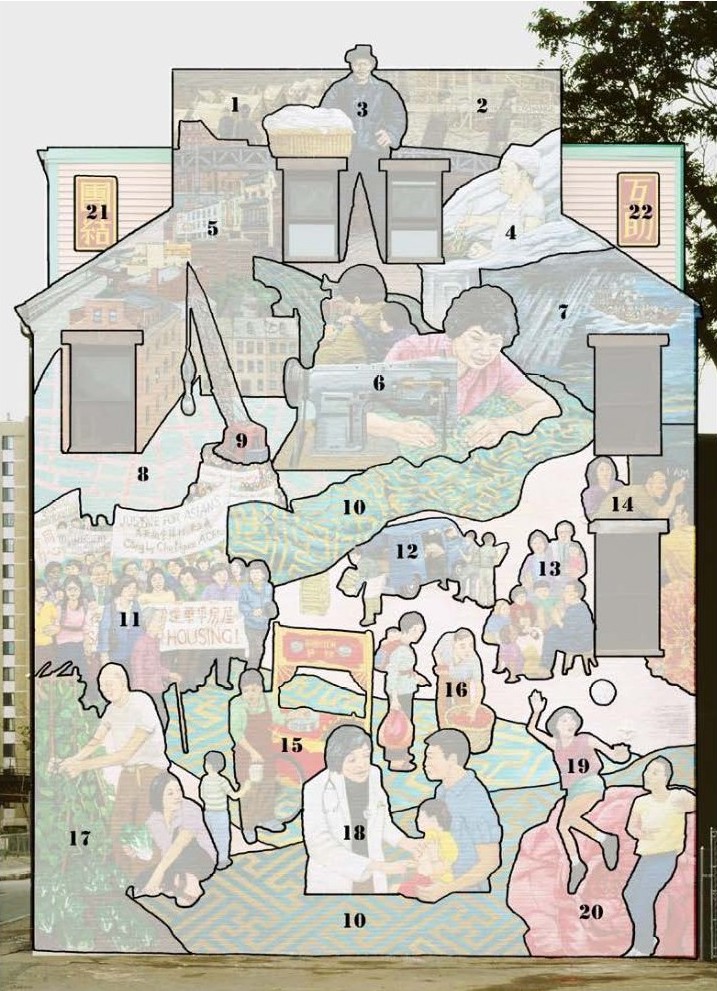
1 – Campsite: In 1870, with work for the Central Pacific Railroad in California completed, and with the Chinese workers facing increasing harassment from the white population, a shoe factory in North Adams, MA recruited 75 Chinese to work in order to break a workers’ strike at a shoe factory. When the strike was settled, the Chinese lost their jobs and migrated to Boston to seek jobs. They camped in what later became the Ping On Alley in present day Chinatown.
2 – Construction Work: One of the first jobs for the Chinese in Boston was as laborers constructing the Pearl Street Telephone Exchange.
3 – The Laundryman: As the labor market was ethnically restricted; the Chinese laborers saved some of their wages not sent home to start businesses to gain some independence. The laundry was one of the few businesses the Chinese were allowed to own in the early 1900s.
4 – The Cook: Started from savings, and loans from mutual help organizations, Chinese restaurants became the other major source of work.
5 – Boston’s Chinatown: During the first half of the 20th century, the Chinese Exclusion Act seriously limiting new immigration. Over time, immigrants created Chinatown to serve the social and material needs of older immigrants and native-born generations of Asians working across Massachusetts in cities and small towns.
6 – The Garment Worker: In 1965, under the new Immigration Act that abolished national-origin quotas, a new wave of Asian immigrants arrived, and with it, women began immigrating in much larger numbers. Not speaking English, many immigrant women were channeled into working as low wage, piecework seamstresses. Bringing income to their families, taking care of children and their household, they became a stable force in the community. During the 1980s, garment production started to move to non-union shops in Southern states or was outsourced to countries in Asia.
7 – The Boat People: With the establishment of the Communist governments in Southeast Asia in the mid-1970s, thousands of refugees from Vietnam, Laos and Cambodia escaped by circuitous routes to America, many through perilous journeys confronting starvation, rough seas and pirates in overcrowded and leaky boats.
8 – Street Map: By the mid-1980s, the integrity of Chinatown, even as it was growing, was seriously threatened by new developments of large establishments such as New England Medical Center and Tufts Medical School.
9 – Demolition: The city demolished many blocks of residential housing in Chinatown and throughout the city for new developments: urban renewal threatened many more.
10 – The Fabric: The traditional, perpetual design of this Chinese fabric is a metaphor for the ongoing continuity and the renewal of strength within the immigrant communities.
11 – Demonstration: In unity, many different Asian groups come together in favor of community control and against further urban renewal that would destroy their communities.
12 – Daily Pickup: With Asian restaurants spread through suburban towns and small communities across New England, vans come to Chinatown in the early afternoon to pick up workers along with groceries. They return in the early hours of the morning after their work shift.
13 – Child Care: With the development of community organizations, child care programs are established to serve community needs.
14 – ESL Class: English as a Second Language classes are organized to help new immigrants broaden their job prospects.
15 – New Enterprise: New entrepreneurs bring new ideas to the community.
16 – New Markets: New varieties of food and culture are introduced to the community.
17 – Community Gardens: Using empty city lots, residents plant elaborate gardens and grow vegetable.
18 – Health Care: Coming together, the community establishes medical services to provide for good local health care.
19 – New Youths: Representing the youth and the future of our community.
20 – Peony: The peony is a traditional Chinese symbol that represents prosperity and distinction.
21 – Unite! Chinese characters for “To unite!”
22 – Help Each Other! Chinese characters for “To help each other!”